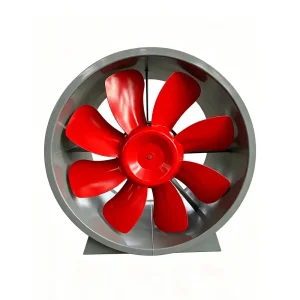
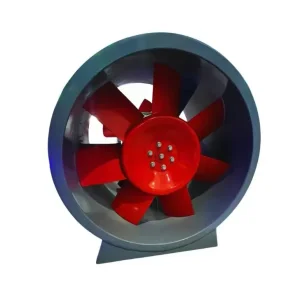
Explore our factory-direct industrial cooling modules, high-efficiency ventilation fans, fire dampers, and modular welded fluid storage systems engineered for rigorous international benchmarks.
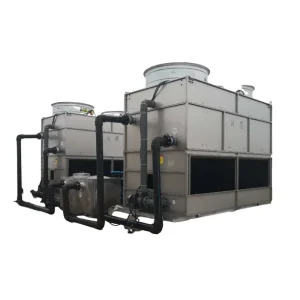

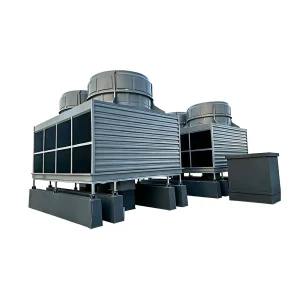
A deep dive into sensible versus latent heat exchange, wet-bulb approach limitations, and next-generation fluid dynamics driving industrial process efficiency.
In modern industrial infrastructure, evaporative cooling towers serve as the definitive thermal heat sinks for continuous processes. Whether cooling multi-megawatt chiller condensers, high-frequency induction furnaces, power turbine circuits, or hyperscale data center loops, the efficiency of an industrial cooling tower dictates the operating margins, lifecycle costs, and carbon footprints of the entire facility.
Fundamentally, industrial cooling towers operate under the principles of concurrent sensible and latent heat transfer. While dry-bulb ambient temperature influences sensible convection, latent heat transfer via mass diffusion accounts for roughly 80% to 90% of total heat dissipation. As process water cascades over surface-enhanced polyvinyl chloride (PVC) or polypropylene (PP) film fill, an infinitesimal fraction (typically 1.5% to 2% per 10°F of cooling range) evaporates into the counterflowing or crossflowing air stream. This thermodynamic mechanism enables the circulating fluid to achieve temperatures well below the ambient dry-bulb temperature, approaching the local atmospheric wet-bulb threshold ($T_{wb}$).
The parameter known as the approach to wet-bulb ($T_{approach} = T_{water,out} - T_{wb}$) represents the fundamental benchmark of cooling tower sizing and efficiency. Engineering a system for an aggressive approach—such as 3°C to 4°C (5.4°F to 7.2°F)—demands exponentially larger heat-transfer fill volume, ultra-uniform non-clogging pressurized distribution nozzles, and precision-engineered aerodynamic fan cowls. Inadequate approach engineering results in soaring compressor head pressures in HVAC chillers, elevated thermodynamic backpressures in steam turbines, and chronic process tripping in metallurgy coils.
Analyzing why international plant owners and EPC contractors are shifting toward modular, closed-circuit, and high-corrosion-barrier custom cooling architectures.
Procurement evaluations have evolved past simple CAPEX. Forward-thinking EPCs evaluate 20-year OPEX: fan motor electrical consumption ($kW/m^3/h$), chemical water treatment cycles of concentration (CoC), and makeup water consumption tariffs.
High-density liquid-to-chip cooling and rear-door heat exchangers require exceptionally reliable chilled water loops. Cooling towers must provide uninterrupted, high-volume heat dissipation with N+1 or 2N mechanical fan redundancies.
Mitigating Legionella pneumophila risks and meeting international acoustic regulations require zero-bypass cellular drift eliminators achieving drift rates <0.001% of circulating volume, alongside ultra-low-noise dynamically balanced airfoil fans.
How advanced structural automation, integrated cluster manufacturing, and full vertical integration eliminate project schedule risks.
Operating directly from Dezhou, Shandong Province—globally recognized as China’s premier HVAC and industrial ventilation equipment manufacturing cluster—our production hub leverages an ecosystem of raw material synthesis, precision sheet-metal pressing, automated fiber-reinforced polymer (FRP) pultrusion, and robotic coil manufacturing. Within our 12,000 m² state-of-the-art facility, we eliminate intermediary subcontractor markup, delivering pristine OEM/ODM equipment straight from the engineering line to global ports.
Our Industry 4.0 manufacturing methodology integrates:
1. Automated CNC Laser Cutting & Robotic Welding: Assuring millimetric precision in structural casing framing, eliminating field assembly bolt misalignment and preserving hot-dip galvanization and SUS304/316 structural integrity.
2. High-Density Closed-Loop Coil Fabrication: Hydraulic expanding of seamless deoxidized copper tubes and continuous serpentine SUS316L stainless steel coils, tested at 2.5 MPa hydrostatic pressure under water immersion to ensure zero leak rates.
3. Advanced Composite Pultrusion: Fabricating non-corrosive structural FRP framing members using premium vinyl ester resins, offering tensile yield strengths exceeding structural structural steel while maintaining total immunity to saltwater and acidic atmospheres.
| Evaluation Parameter | Fengdun Dezhou Factory 4.0 Direct | Conventional Trading Intermediaries | Western Tier-1 OEMs |
|---|---|---|---|
| Direct CAPEX Cost | Factory-direct pricing; transparent bill of materials. | Marked up 25%–45% via multi-tier brokerage. | High premium driven by Western overheads. |
| Lead Time (Standard Packages) | 3 to 5 weeks via localized component supply cluster. | 8 to 14 weeks due to outsourced coordination lag. | 16 to 26 weeks due to backlog bottlenecks. |
| Structural Customization | 100% custom dimensions, shell alloys & coil metallurgy. | Restricted to standard catalog sizes. | High engineering fee for custom alterations. |
| Quality Control Testing | In-house hydrostatic, fan balancing, and run-testing. | Blind third-party factory drop-shipping. | Factory tested, but high verification costs. |
Choosing the exact fluid configuration based on water chemistry, process sensitivity, and ambient fouling factors.
Process engineers frequently face the decision between selecting an Open Counterflow Cooling Tower and an Enclosed Closed-Circuit Fluid Cooler. The decision hinges entirely upon process cleanliness requirements, fluid contamination risks, scaling potential, and overall site layout economics.
| Performance Dimension | Open Counterflow Cooling Tower | Closed-Circuit Cooling Tower (Fluid Cooler) |
|---|---|---|
| Circulating Fluid Quality | Process water is open to ambient dust, airborne particulates, and biological fouling. Requires continuous chemical treatment. | Process fluid remains 100% sealed inside pristine copper or stainless steel coils. Zero contamination or airborne scaling. |
| Ideal Applications | Centrifugal HVAC chillers, power plant turbine exhausts, coal gasification scrubbing, and general municipal cooling. | Induction melting furnaces, data center liquid loops, pharmaceutical reactors, plastic extrusion, and vacuum furnaces. |
| Initial Capital Expenditure | Lowest initial CAPEX per nominal heat rejection ton. | Moderate to higher initial CAPEX due to specialized internal heat exchange coils and auxiliary spray pump systems. |
| Maintenance Overhead | Periodic basin desludging, biocidal chemical dosing, and mechanical fill descaling required. | Virtually zero internal circuit maintenance; process equipment heat transfer surfaces remain pristine for decades. |
| Free Cooling Capability | Requires intermediate plate heat exchanger (PHE) to avoid chiller fouling during economizer mode. | Direct dry/wet free cooling without intermediary heat exchangers during low ambient temperature seasons. |
From tropical industrial corridors in Southeast Asia to hyper-arid desert facilities, our cooling equipment is purpose-built for harsh environmental operational profiles.
Deployed across chemical processing and power plants in Vietnam, Thailand, and Indonesia. Engineered to perform in extreme tropical environments with wet bulbs of 29°C (84.2°F). Features non-clogging splash fills and anti-algae UV-stabilized FRP casings that resist heavy biofouling and fungal growth.
Installed across petrochemical refineries and extraction plants. Equipped with heavy-gauge SUS316 casing panels, sand-filtering intake louvers, and titanium heat exchanger coils engineered to withstand total dissolved solids (TDS) exceeding 30,000 ppm and airborne dust storms.
Configured for metropolitan district cooling and mission-critical cloud compute facilities. Utilizing EC variable-speed direct-drive permanent magnet synchronous motors (PMSM) paired with bellmouth aerodynamic diffusers to achieve stringent municipal noise limits (<55 dB(A) at 10 meters).
Certified engineering workflows conforming to CTI, ISO, and CE specifications for seamless project commissionings worldwide.
Every cooling tower, fire damper, mixed-flow fan, and welded water storage vessel exiting our Dezhou manufacturing complex undergoes an unyielding factory acceptance testing (FAT) protocol designed to eliminate field rectification expenses for EPC contractors:
CTI STD-201 Thermal Performance ISO 9001:2015 Quality Systems ISO 14001 Environmental Management CE Machinery & Pressure Directives SGS & Bureau Veritas Inspected
Our quality verification process incorporates:
• Full Dynamic Balancing of Impellers: Standard fan assemblies undergo dynamic balancing according to ISO 1940 Grade G2.5, ensuring vibration velocities below 2.0 mm/s RMS for ultra-long bearing longevity.
• Hydrostatic Pressure Testing: Closed-circuit heat transfer coils are pressurized to 1.5x the maximum design working pressure (minimum 25 bar) for 30 minutes with continuous pressure tracking.
• Structural Wind & Seismic Analysis: All casing frames are engineered to withstand typhoons and seismic forces conforming to IBC (International Building Code) and ASCE 7 standards.
Direct, highly authoritative answers addressing technical specifications, system integrations, and procurement guidelines.
Factory-direct industrial square cooling towers, emergency smoke management systems, and specialized pressure storage tanks backed by 15+ years of verified excellence.