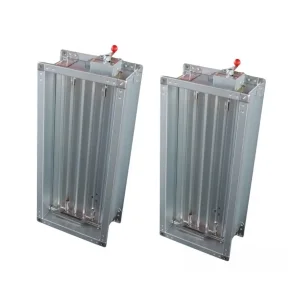
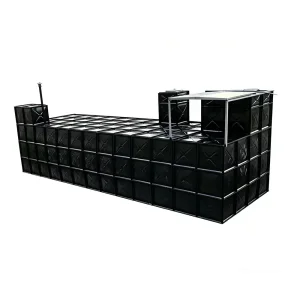
Direct factory manufacturing specifications. All inline booster units, smoke dampers, and closed fluid loops are calibrated for minimal static pressure drop and maximum aeromotive efficiency.

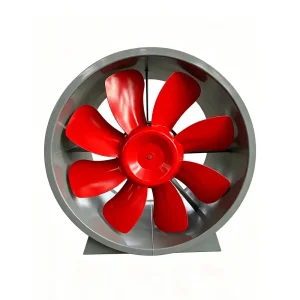
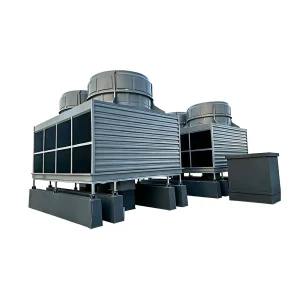
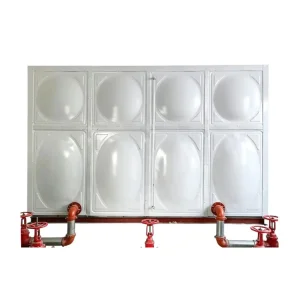
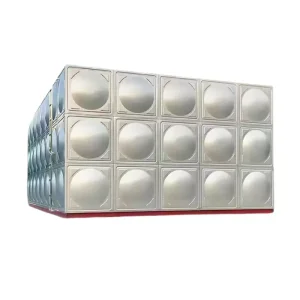
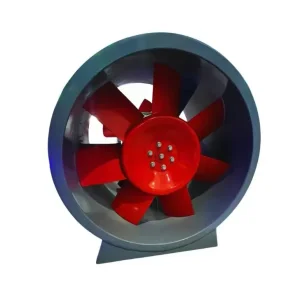
In modern expansive built environments—spanning mega-warehouses, data centers, and multi-tiered commercial towers—primary Air Handling Units (AHUs) consistently face pressure degradation over extended duct runs.
Ductwork systems are vulnerable to cumulative friction losses governed by the Darcy-Weisbach equation and dynamic resistance from bends, transitions, dampers, and terminal diffusers. As duct runs exceed 30 to 50 meters, standard AHU central blowers fail to deliver nominal cubic feet per minute (CFM) to terminal zones, precipitating stagnant air pockets, thermal stratification, and indoor air quality (IAQ) compliance failures under ASHRAE Standard 62.1.
As premier HVAC Duct Booster Fan Manufacturers, our engineering framework resolves duct static pressure deficits ($P_s$) through aerodynamically profiled inline mixed-flow booster modules. Rather than over-sizing primary central chillers—which inflates operational expenditure—precision booster fans reinforce localized static pressure at critical junctions.
Global regulatory bodies, including the EU’s Ecodesign Directive (ErP Lot 11) and the U.S. Department of Energy (DOE) energy conservation standards, mandate aggressive reductions in Specific Fan Power (SFP). HVAC designers can no longer afford the energy penalties of high-resistance throttle dampers.
By integrating aerodynamically balanced inline mixed-flow impellers powered by Electronically Commutated (EC) or Permanent Magnet Synchronous Motors (PMSM), modern duct booster fans achieve wire-to-air efficiencies exceeding 70%, slashing total building lifecycle operating expenses.
Inline booster systems regenerate up to 850 Pa of static pressure, compensating for pressure-drop spikes caused by downstream HEPA filters, activated carbon beds, and complex branch elbows.
Facilitates autonomous multi-zone demand control ventilation (DCV) through automated 0-10V or 4-20mA signals, preventing branch starving without overloading neighboring duct trunks.
Engineered double-skin acoustic cabinet casings lined with high-density micro-perforated sound attenuation materials attenuate blade pass frequency (BPF) noise down to ≤ 48 dB(A).
Comparing classical pure axial/centrifugal topologies with next-generation high-pressure mixed-flow duct boosters built in our Dezhou manufacturing facility.
Traditional inline axial fans produce exceptional volumetric airflow but lack the static pressure required to overcome extensive duct network resistance. Conversely, pure centrifugal fans generate strong static pressure but create 90-degree airflow turns that mandate awkward, space-consuming duct transitions.
Our mixed-flow booster configurations resolve this geometric compromise. By utilizing 3D backward-curved diagonal blading with conical hub architecture, airflow undergoes continuous radial acceleration without directional diversion. This generates up to 2.4 times higher static pressure than conventional axial fans while preserving a streamlined inline form factor.
Induction AC motors modulated via traditional triac voltage controllers suffer from electromagnetic hum, harmonic distortion, and severe motor overheating at low speeds. Our manufacturing process incorporates brushless EC motor architecture featuring integrated microprocessor-driven inverters.
These smart drives sustain peak efficiency across the entire speed envelope, accepting Modbus-RTU, BACnet-MS/TP, or analog signals for real-time airflow modulation based on static pressure feedback or IAQ sensor inputs.
| Fan Engineering Class | Airflow Capacity (m³/h) | Static Pressure Range | Motor Topology | Specific Fan Power (SFP) | Acoustic Rating dB(A) |
|---|---|---|---|---|---|
| Industrial Mixed Flow Booster | 1,200 – 28,000 | 250 – 850 Pa | EC / High-Efficiency AC | 0.72 – 1.15 W/(m³/h) | 46 – 62 |
| Soundproof Cabinet Booster | 800 – 16,500 | 180 – 620 Pa | Direct-Drive Brushless EC | 0.68 – 0.98 W/(m³/h) | 38 – 52 |
| High-Temp Smoke Extraction Booster | 3,500 – 85,000 | 350 – 1,200 Pa | Class H High-Temp AC | 1.10 – 1.65 W/(m³/h) | 64 – 78 |
| Standard Inline Axial Duct Fan | 500 – 6,000 | 50 – 180 Pa | Shaded Pole / PSC | 1.30 – 1.95 W/(m³/h) | 58 – 72 |
From mission-critical data server halls to extreme thermal industrial production plants, our manufactured duct boosters deliver targeted airflow where standard air handlers cannot reach.
High-density computing racks demand localized pressurized cold-air delivery. Inline booster units pull conditioned air through raised access flooring, eliminating high-temperature hotspots and preventing server thermal throttling without needing full CRAC system replacements.
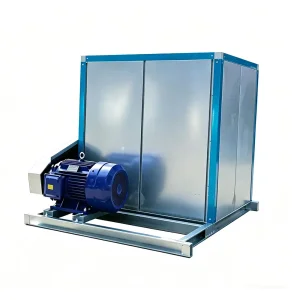
Exhaust runs from restaurant kitchens to rooftop discharge frequently encounter heavy resistance from electrostatic precipitators and charcoal filters. Out-of-airstream motor cabinet booster fans provide high-suction negative pressure while keeping motors isolated from greasy airstreams.
Pharmaceutical and microelectronics cleanrooms rely on strict differential pressures. Our booster fans deliver constant CFM against loading HEPA filters, paired with airtight welded casings that prevent cross-contamination in ISO 14644-1 controlled facilities.
Tested for continuous operation at 280°C for up to 120 minutes, these dual-purpose units provide daily low-noise ambient ventilation, while transitioning instantly to emergency smoke purge mode via automated fire alarm triggers.
Combats carbon monoxide (CO) stagnation in subterranean transit garages. Mixed-flow booster units integrate with CO sensors to purge heavy particulates, driving toxic pollutants toward main vertical exhaust shafts.
Built using premium SUS304/SUS316 stainless steel or specialized FRP coatings, our corrosive-duty booster units safely extract corrosive industrial fumes, offshore salt air, and chemical off-gassing without structural degradation.
Detailed engineering procedures to resolve static pressure deficits in existing HVAC networks without costly architectural renovations.
The operational duty point of any duct booster fan occurs at the intersection of the Fan Performance Curve and the System Characteristic Curve, defined by:
Where ΔP_s represents total static pressure loss, K is the comprehensive duct resistance coefficient, ρ is air density, and Q is volumetric flow rate. In retrofitted legacy buildings, changes in space utilization often add high-resistance duct runs, moving the system curve into the fan stall or surge region.
Our engineers perform fluid-dynamic audits to size inline booster fans that absorb the incremental resistance (ΔP_booster), restoring the primary AHU to its peak efficiency range without over-pressurizing upstream ductwork.
Introducing booster fans into occupied spaces can lead to noise complaints if not properly engineered. High-pressure impellers generate aerodynamic turbulence and structure-borne vibration if rigidly mounted.
To eliminate these acoustic issues, our turnkey booster designs incorporate flexible canvas/neoprene duct connectors, internal spring vibration isolators, and double-wall soundproof enclosures. By isolating mechanical vibrations and dampening low-frequency sound waves, our booster systems maintain ambient NC-35 or lower ratings in occupied architectural spaces.
Shandong Fengdun Environmental Technology Co., Ltd. delivers direct factory engineering, backed by 15+ years of dedicated HVAC innovation and integrated regional supply chains.
Situated in Dezhou, Shandong—China's renowned hub for ventilation, fire exhaust, and industrial cooling hardware—our 12,000 m² production complex houses automated CNC laser cutting, robot welding stations, hydraulic sheet metal presses, and aerodynamic testing tunnels.
Under our proprietary "Feng Shield" engineering brand, we supply contractors, EPC developers, and overseas industrial distributors directly, eliminating intermediary trading markups while offering complete design flexibility for custom dimensions, custom voltages, and specialized anti-corrosion finishes.
Having served more than 200 international clients across Southeast Asia, the Middle East, Central Asia, and Europe, our equipment meets stringent global specifications. We work directly with third-party testing agencies like SGS, BV, and TÜV to provide rigorous pre-shipment inspections and verified performance test data.
Our engineering documents include complete factory acceptance test (FAT) reports, material mill certificates for SUS304/SUS316, and full compliance documentation for CE and ISO 9001 standards.
Frequently asked technical questions regarding sizing, motor topologies, noise attenuation, and factory-direct OEM customization.
Explore our factory-direct industrial equipment portfolio. All units are manufactured in Dezhou, Shandong, China, and tested to international engineering standards.